
Among the Smoke, She Planted Hope. The Tale of Lady Dahlia Rosewick

Updated: Jun 7
By Angela McPherson
(with assistance from AI)

Before she was known as Lady Dahlia Harestitch, she was simply Lady Dahlia Rosewick, daughter of one of the oldest floriculturist families in the region.
Long before factories rose above the rooftops and smoke filled the skies, the Rosewick family had been caretakers of flowers. For generations, they collected seeds, preserved heirloom varieties, nurtured rare blooms, and passed down their gardening knowledge from one generation to the next.

The Rosewicks were known throughout the countryside for understanding every step of a flower's journey. Some family members carefully harvested and stored seeds, ensuring each new season would bring fresh blossoms. Others tended greenhouses and growing fields where flowers were planted, watered, pruned, and protected from pests and harsh weather. A few specialized in breeding stronger and more beautiful varieties, creating blooms with richer colors, longer stems, and sweeter fragrances.
As the family grew, so did their trade. Several Rosewicks owned flower shops in villages and towns, where they transformed fresh-cut flowers into elegant bouquets and arrangements for celebrations, weddings, and everyday joys. Others traveled far beyond their gardens, transporting flowers by wagon, rail, and boat to distant cities throughout the country. They learned the careful art of harvesting blooms at just the right stage, conditioning them in water, and packing them safely so they would arrive fresh and beautiful days later.

But as the city grew larger and industry spread across the landscape, life began to change. Factories rose where gardens once bloomed, and flower fields were gradually replaced by brick buildings, smokestacks, and machinery. Many rabbits still loved flowers, but fewer could afford the luxury of growing them.
The Rosewick family felt those changes deeply. As business declined and mouths became harder to feed, many family members made difficult choices. Some sold their flower fields. Others closed their shops and found work in the factories that now dominated the city skyline. One by one, branches of the family traded petals for paychecks, hoping to provide a better future for their young.
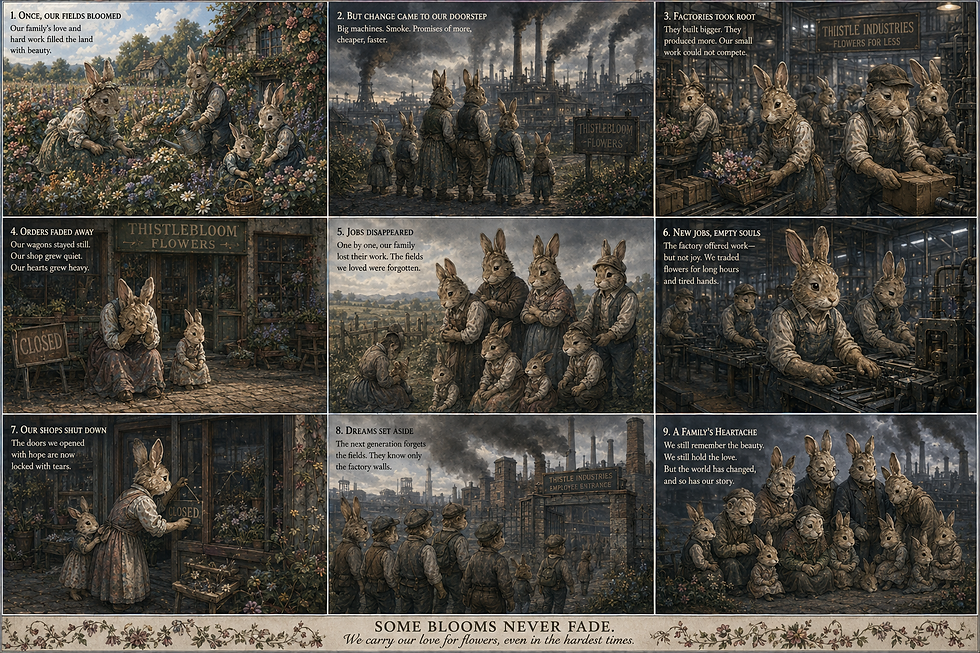
Dahlia watched these struggles unfold throughout her childhood. She understood why her family made those choices, but each time another garden disappeared, her heart ached. She could not bear the thought of seeing every flower field replaced by smoke and steel.
So, she made a promise to herself.
No matter how difficult life became, she would continue growing flowers. She would protect the traditions her ancestors had passed down for generations. And she would never sell her beloved cottage, The Hidden Bloom, to become another factory covered in soot and grime.
As long as Dahlia Rosewick tended her garden, there would always be one place where beauty still bloomed.

The Hidden Bloom was located beyond the city limits, at the end of a winding country path, and stood as flower-covered cottage surrounded by gardens. Though it was not marked on any map and bore no sign above its door, locals knew where to find it. They came for fresh bouquets, rare flowers, and the quiet comfort that only The Hidden Bloom could provide.

Dahlia spent her days tending roses, lilies, daisies, and heirloom varieties preserved by generations of Rosewicks before her. She knew every blossom by name and could tell when a plant needed water simply by looking at it. While factories continued to spread across the landscape, Dahlia quietly protected a small corner of the world where nature still flourished.
She was perfectly content with her flowers. Or at least she thought she was.
How Lady Dahlia Rosewick Came to Life Through Fabric Appliqué
and Thread Sketching
When I first created Mr. Edwin Harestitch, I knew his story wasn't complete. Every good tale deserves a heroine, and Edwin's portrait needed a companion. That companion became Lady Dahlia Rosewick, a gentle floriculturist whose love of flowers would eventually intertwine with Edwin's own story.
One of my favorite details in Dahlia's portrait is the flower she holds. If you look closely at Edwin's portrait, you'll notice he carries the Zinnia flower.
(The Zinnia flower is actually a wonderful symbol for Edwin and Dahlia because it is known for being a hardy flower that thrives in difficult conditions. Zinnias bloom through heat, drought, poor soil, and challenging weather. They don't require perfect conditions to flourish. Just as the zinnia flourishes despite harsh conditions, Edwin and Dahlia found friendship, hope, and eventually love during a time when both of their worlds were changing. The flower became a quiet reminder that resilience and beauty often grow side by side.)
Building Dahlia with Fabric and Thread
Like many of my art quilts, Dahlia began as a collection of carefully selected fabrics. Each fabric was chosen not only for color but also for texture and personality. Her warm brown fur, delicate cream accents, and rosy Victorian-inspired dress all work together to create a soft cottagecore aesthetic with a touch of steampunk whimsy.
After the appliqué pieces were assembled, I moved to one of my favorite stages:
thread sketching.
Thread sketching allows me to draw with my sewing machine much like an artist draws with a pencil. Using free-motion stitching, I outlined Dahlia's features, added folds to her clothing, defined the petals of her flower, and created expressive details around her eyes and whiskers. The stitching gives dimension and movement that would be impossible to achieve with fabric alone.
The black thread lines help define the illustration, while additional stitching adds texture and visual depth throughout the piece. Every pass of thread contributes to the character's personality, bringing her a little closer to life.
The Little Details Matter
One of the joys of creating art quilts is finding opportunities to add unexpected embellishments.
To give Dahlia a touch of Victorian elegance, I incorporated a piece of delicate lace around her collar. The lace adds softness and realism while creating a beautiful contrast against the structured stitching and appliqué.


I also added miniature doll buttons to her dress and collar. These tiny embellishments may be small, but they create a surprising amount of visual interest. The pearl-like buttons catch the light and add a sense of refinement that feels perfectly suited to Lady Dahlia's character.


At her neckline, a decorative embellishment was added as a finishing touch, creating the appearance of a cameo brooch and helping draw the viewer's eye toward her face.
These little additions transform the quilt from a flat illustration into something that feels almost tangible.
Creating Dimension with Double Batting
One technique I often use in my art quilts is layering batting to create dimension.
For Dahlia's portrait, I used two layers of batting to help her stand out from the background. The extra loft creates subtle trapunto-like dimension, allowing the portrait area to rise slightly above the surrounding frame.


This added depth becomes especially noticeable when viewing the quilt from the side. The raised surface catches light differently, creating natural shadows that enhance the three-dimensional effect. It helps Dahlia feel less like an image on fabric and more like a treasured portrait hanging in an old Victorian home.
A Matching Portrait for Edwin
To further connect the two characters, Dahlia's portrait was finished in the same decorative fabric frame style used for Edwin's portrait.
The matching frames create a sense of unity between the pieces, almost as if they belong in a family gallery wall. When displayed together, the portraits immediately feel like companions. The shared flower, coordinating color palette, and matching frame treatment all reinforce the story connection between Edwin and Dahlia.
While each rabbit has their own unique personality and style, the portraits were designed to complement one another and serve as visual bookends to the beginning of their tale.
More Than a Quilt

What began as fabric, thread, lace, and a handful of tiny buttons became something much more meaningful. Dahlia is not simply an art quilt—she is a character, a storyteller, and an important part of Edwin's world.
Every stitch, embellishment, and design decision was made to help bring her personality to life. From the shared flower she holds to the dimensional batting beneath the surface, each detail helps tell the story of Lady Dahlia Rosewick long before a reader ever turns the first page.
And now, with Dahlia standing beside Edwin, their story can truly begin.
Until Next Time - Keep Creating
~Angela McPherson
*A Note About AI
I believe creativity comes from ideas, imagination, and storytelling. For the Dahlia and Edwin series, I use AI as a collaborative tool to help illustrate scenes and develop story concepts. Every image, character, storyline, and final creative decision is guided by me.
Just as quilters use sewing machines and photographers use cameras, I use modern creative tools to help bring my vision to life. The stories, direction, editing, and artistic choices remain my own.
If you’ve ever wanted to create whimsical art quilts like Mr. Edwin Harestitch and Lady Dahlia Roswick, this is exactly the kind of thing I teach in my Creative Spark classes.

In Thread Sketching for Beginners, you’ll learn how to use your sewing machine like a drawing tool while practicing stitching styles, texture, movement, shading, and expressive line work that brings fabric art to life.
Then in Thread Sketching Appliqué, we take those skills even further by combining appliqué and expressive stitching to create dimensional quilts filled with personality, storytelling, and charm.

You’ll learn how to:
Build layered appliqué designs
Add texture and movement with thread sketching
Create dimensional effects with quilting
Add expressive stitched details
Blend storytelling with fabric art
Turn simple shapes into whimsical characters full of life
Because sometimes all it takes is fabric, thread, imagination… and one sentimental rabbit carrying his mother’s favorite flower to remind us that softness still belongs in this world — even among the gears.
P.S. Some of the links shared in this post are affiliate links, which means I may earn a small commission if you purchase through them — at no extra cost to you. Thank you for supporting my art, classes, and slightly dramatic rabbits. 💕


Comments